
What a Land Broker Brings to the Table
When people think about real estate, they often think of homes, neighborhoods, and residential agents. Land is different.
Vacant land, development tracts, agricultural properties, timberland, recreational acreage, and transitional land require a completely different skill set. The factors that create value for land are often invisible to the average buyer and seller. That's where a land broker becomes invaluable.
Land Is More Than Dirt
Every parcel tells a story.
The question is not simply, "What is this land worth today?"
The real question is:
- What can it become?
- What can legally be built on it?
- What are the highest and best uses?
- What risks exist beneath the surface?
- Who is the most likely buyer?
A skilled land broker helps answer those questions before a property ever reaches the market.
Understanding Highest and Best Use
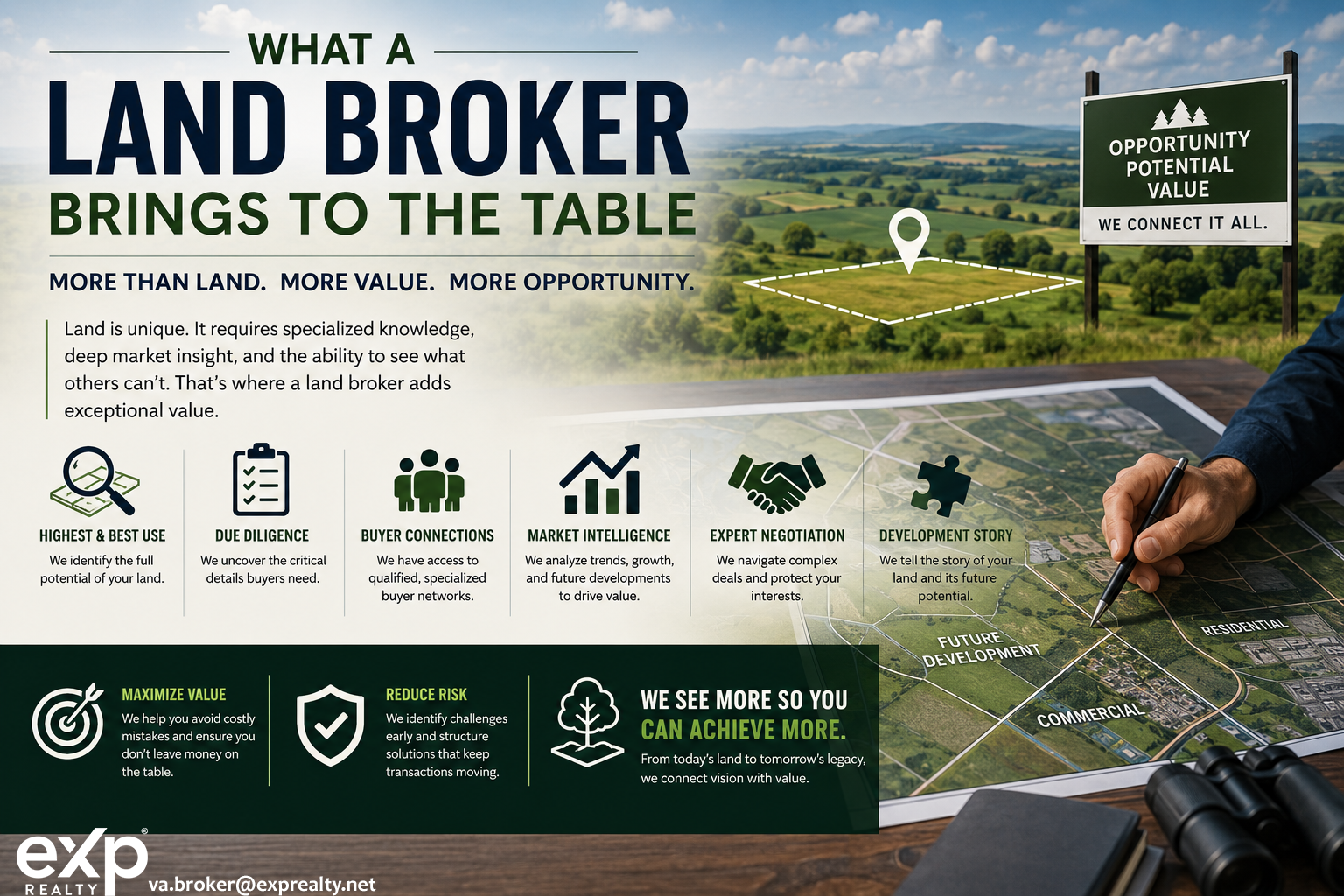
One of the most important services a land broker provides is identifying a property's highest and best use.
A 20-acre tract may be:
- A future residential subdivision
- A commercial development site
- A solar farm opportunity
- Agricultural land
- Recreational property
- Timber investment land
Each use attracts a different buyer and creates a different value.
The difference between marketing land as "20 acres for sale" and marketing it as "a future development opportunity" can be hundreds of thousands of dollars.
Due Diligence Before Marketing
Experienced land brokers understand that buyers want answers.
Before marketing a property, a land broker often researches:
- Zoning classifications
- Comprehensive land use plans
- Utility availability
- Water and sewer access
- Road frontage
- Easements
- Floodplain impacts
- Wetlands
- Soil conditions
- Topography
- Access rights
- Environmental concerns
This information reduces uncertainty and helps buyers make informed decisions.
Access to Specialized Buyers
The buyer for a home is usually a family.
The buyer for land could be:
- Developers
- Builders
- Investors
- Farmers
- Timber companies
- Utility companies
- Renewable energy developers
- Conservation organizations
- Recreational land buyers
Land brokers maintain relationships with these specialized buyer pools and understand what motivates each one.
Many land transactions never reach public listing platforms because qualified buyers are contacted directly.
Market Intelligence Beyond Comparable Sales
Residential agents often rely heavily on comparable sales.
Land valuation requires a broader approach.
A land broker studies:
- Development activity
- Population growth
- Infrastructure projects
- Utility expansions
- Traffic patterns
- Employment centers
- School growth
- Future transportation improvements
A new road, utility extension, or planned development can dramatically alter land values long before the general public notices.
Negotiating Complex Transactions
Land transactions frequently involve issues that don't exist in traditional residential sales:
- Survey concerns
- Boundary disputes
- Mineral rights
- Timber rights
- Agricultural leases
- Hunting leases
- Access easements
- Development contingencies
- Entitlement periods
- Feasibility studies
- Environmental inspections
A land broker helps structure agreements that protect clients while keeping transactions moving forward.
Creating a Development Story
The best land brokers don't simply market acreage.
They create a narrative.
They help buyers understand:
- Why the property matters
- What opportunities exist
- What challenges must be solved
- How the property fits into future growth patterns
In many cases, buyers are purchasing future potential rather than current use. Communicating that potential effectively is often the difference between an average sale and an exceptional one.
Protecting Sellers From Leaving Money on the Table
One of the greatest risks landowners face is selling without understanding what they own.
A parcel that appears to be farmland today may sit directly in the path of future growth. A broker who understands local planning, infrastructure investment, and development trends can help owners avoid undervaluing their property.
The goal is not simply to sell land.
The goal is to maximize value while minimizing risk.
The Bottom Line
Land brokerage is a specialized discipline that combines real estate, planning, development, valuation, negotiation, and market intelligence.
A good land broker helps clients see beyond the property as it exists today and understand what it may become tomorrow.
Because in land brokerage, the most valuable asset isn't the acreage itself.
It's the ability to interpret its future.
The best land brokers don't just sell land. They uncover opportunity, reduce uncertainty, and connect vision with value.
Check out this article next